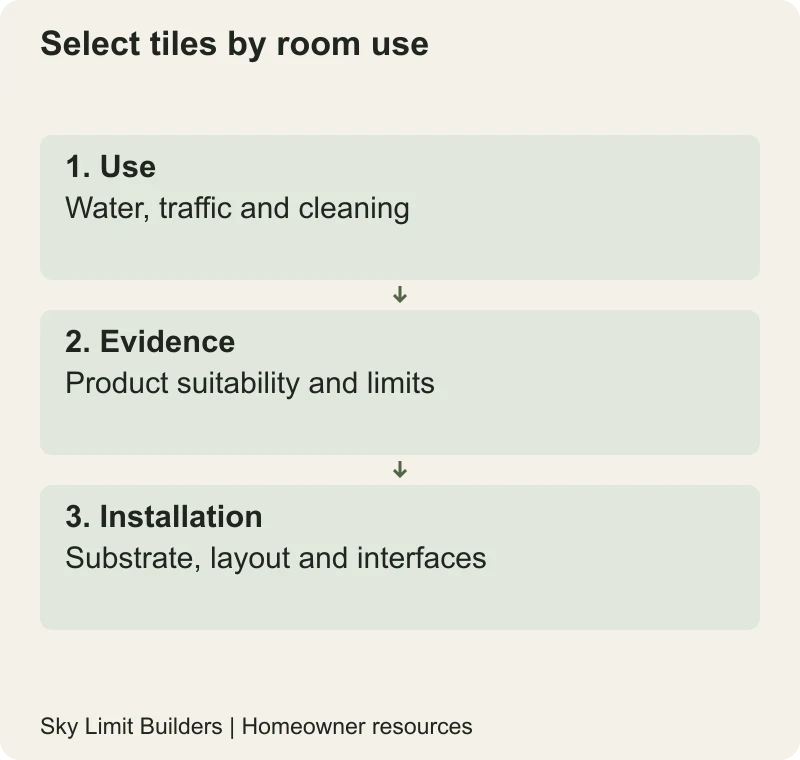
The right floor tile is one that suits the room’s water exposure, traffic, cleaning and installation conditions. A tile that looks good in a showroom can still be unsuitable for a wet entrance or awkward to lay around a shower drain. Start with the use of each floor rather than assuming porcelain, a matte finish or a higher price automatically makes it safer.
Give every room a use description
| Area | Questions before selection |
|---|---|
| Living room | How will the finish look in natural light, and what cleaning method is practical? |
| Kitchen | How will spills, grease and frequent cleaning be managed? |
| Bathroom | Is the product suitable for the actual wet use, including shower areas where applicable? |
| Entrance or terrace | Is the tile suitable for exterior exposure, drainage and regional conditions? |
Ask the supplier for the exact product’s intended-use classification and test information. A wall tile should not be assumed suitable for a floor. Ceramic and porcelain descriptions are not complete specifications: dimensions, finish, use limitations and the installation system still matter.
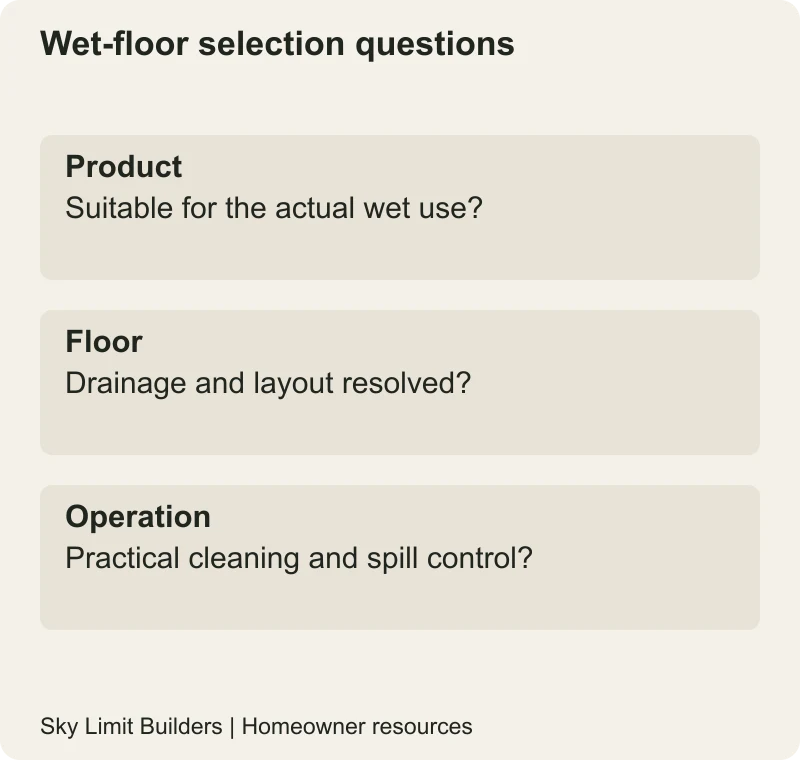
Do not equate “matte” with slip-proof
Daltile’s DCOF guidance explains that no floor tile is slip-proof and that product choice must be considered with the intended use, maintenance, and likely contaminants. A friction number alone does not describe every floor in service. Treat it as evidence to discuss with the specifier, not a guarantee against falls or a Pakistani regulatory rule.
Ask how the proposed tile will be used with drainage, cleaning, footwear and likely contaminants. For a family bathroom, explicitly discuss barefoot use rather than relying on a showroom walk in dry shoes. Choose a maintenance routine the household can sustain, and investigate persistent water on the floor instead of treating it only as a tile-selection problem.
Check the substrate and layout before ordering
The substrate is the surface supporting the tile installation. Ask the installer to inspect its condition, levels and readiness and to identify the compatible adhesive, grout, waterproofing where required and movement-joint details. Do not ask workers to conceal an unresolved leak or moving crack under new tiles. Refer to the waterproofing guide before closing wet areas.
Prepare a layout showing door thresholds, drains, visible edges and major cuts. Large formats can create difficult cuts around small spaces; a smaller format can introduce more joints to clean. Neither is universally better. An illustrative decision: compare two layouts for the same bathroom and count awkward cuts and drain interfaces before choosing by tile size.
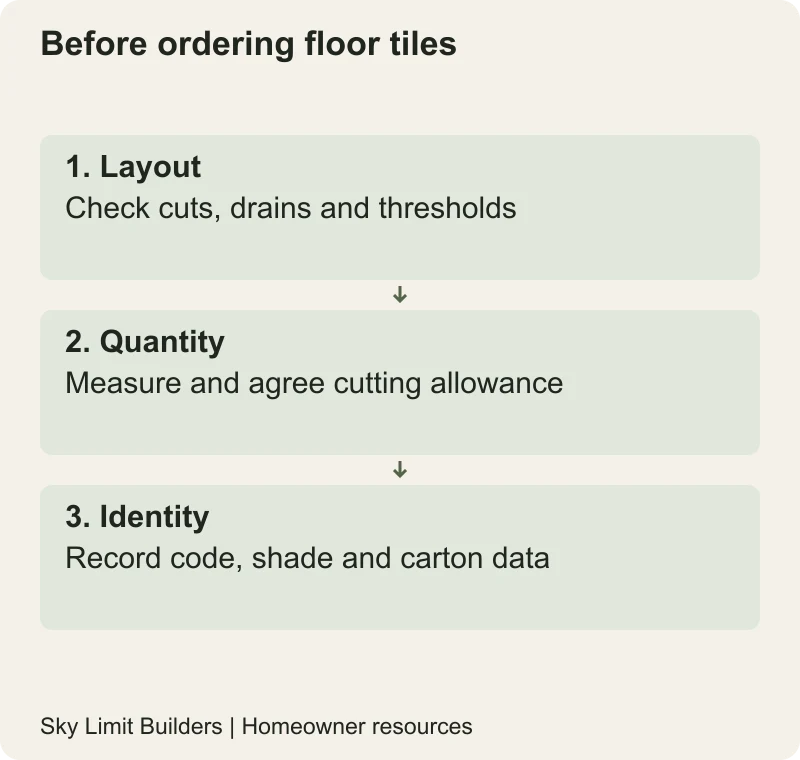
Order an identifiable batch
- Record the manufacturer, product code, finish, size and shade or calibre information supplied on the cartons.
- Agree the measured area, cutting allowance and spare quantity with the installer; do not use an unexplained universal waste percentage.
- Confirm availability for the whole room and replacement terms before installation.
- Inspect samples from delivered cartons against the approved sample and report differences early.
- Keep labelled spare tiles and purchase records for repairs.
For a Multan site, confirm transport and unloading responsibilities and a protected storage location. A discontinued bargain may be poor value if the available quantity cannot complete the floor or replacements cannot be sourced. Likewise, an imported product is not inherently better than a regionally available one with the right documentation and support.
Inspect before the room is accepted
Ask the contractor to demonstrate the completed drainage arrangement where applicable, check transitions and inspect visible alignment, damaged edges and finish consistency. Record defects by location with photographs. Follow the installation products’ instructions before allowing traffic or cleaning. Our handover checklist helps organise these records.
A qualified designer or competent tiling specialist should specify safety-critical wet-area details. This article is a selection checklist, not an installation specification or a promise that any floor is slip-proof.