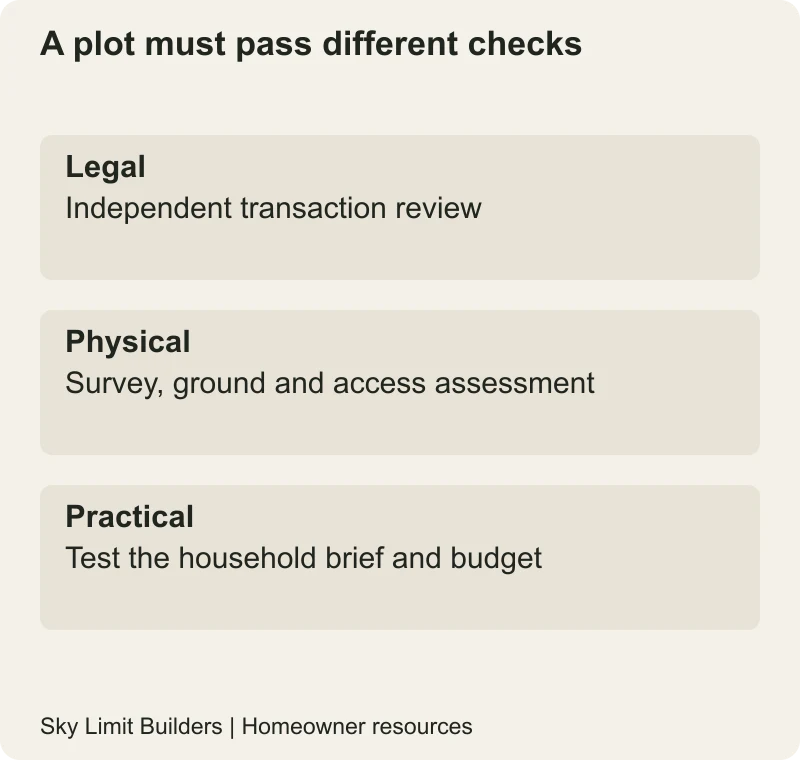
Before buying a residential plot, test two separate questions: can the seller legally transfer the property, and can you build the house you need on it? An attractive location or a society brochure does not answer either question. Organize the purchase around documented checks before an irreversible payment.
Separate legal verification from construction feasibility
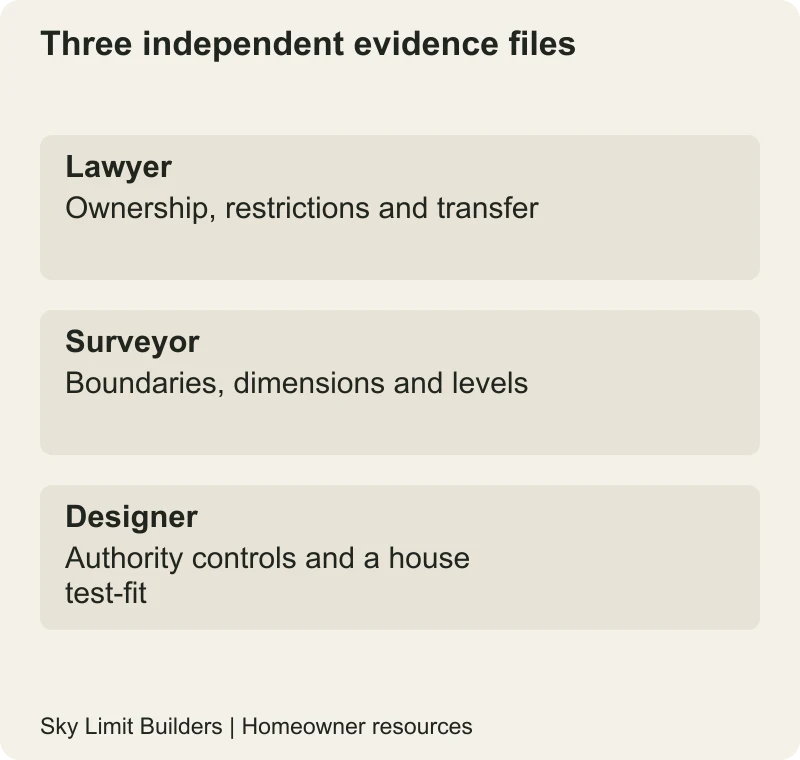
Engage a qualified regional property lawyer to establish the relevant ownership records, transfer requirements, restrictions and outstanding issues for the specific property. In Punjab, the Punjab Land Records Authority is an official route for relevant land-record services. The correct records and process depend on the property; an online result or a photograph of a document is not a complete legal opinion.
Where a housing society or development authority is involved, confirm the plot identity, development/possession status and applicable building controls directly. Keep the date and source of the response. Ask your lawyer which payments or documents must be conditions of the transaction. This guide does not certify title or recommend an investment.
Check dimensions and usable space
Have a competent surveyor confirm the plot geometry and boundaries. Ask the architect to use those dimensions and the applicable setbacks in a simple feasibility layout. Do not convert the advertised marla or kanal description into a floor plan without checking the authority’s actual area convention and the surveyed dimensions.
The test-fit should show required rooms, parking, stairs, light and ventilation, not just a possible covered area. For an irregular plot, ask where the compromises fall. A narrower entrance or a chamfered corner can matter to the household even when the total area sounds generous.
Visit with a construction checklist
- Levels: request a survey showing the relationship to the road and adjoining properties.
- Ground: record visible filling, standing water or signs of disturbance without guessing bearing capacity.
- Access: identify realistic delivery access, overhead obstructions and material-storage limitations.
- Neighbours: note adjoining construction, privacy constraints and access arrangements that may need agreement.
- Services: seek confirmation of connection availability and process from the relevant providers.
A dry-day viewing does not establish drainage performance. Ask about documented drainage arrangements and any known issues; if possible, visit after rain without entering unsafe excavations or flooded areas. Commission the appropriate ground investigation for the design rather than relying on the appearance of the surface.
Compare plots using unresolved issues, not just scores
| Question | Evidence | Status |
|---|---|---|
| Ownership and transfer | Lawyer’s verified document list | Verified / unresolved |
| Building envelope | Current authority response and architect’s test-fit | Meets brief / revise brief |
| Ground and levels | Survey and professional advice | Assessed / investigation needed |
| Utilities | Provider response and connection scope | Confirmed / provisional |
Do not let a high score for location cancel an unresolved title question. Separate matters that can be priced from matters that must be resolved before purchase. Record the person responsible for obtaining each missing item and the date by which you need it.
Budget beyond the land price
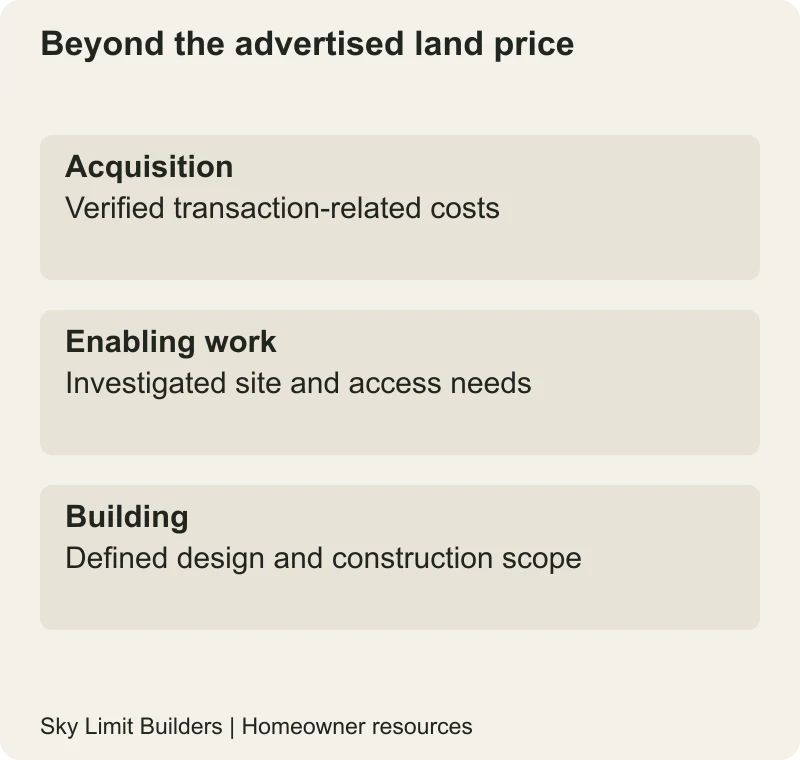
Ask the cost adviser to distinguish acquisition expenses, enabling work, connections and the building itself. Potential items to investigate include survey, approvals, ground preparation, temporary access and service connections; not every plot requires every item. Use dated written estimates with scope, not an unsupported nationwide “extra cost” percentage.
For an overseas owner, nominate an authorized representative and agree how original documents, site visits and payments will be checked. Keep advice from the lawyer, surveyor and designer traceable rather than merging it into a sales conversation.
Before making the purchase decision, collect the legal review, survey, authority response, concept test-fit and preliminary cost risks. Bring the feasibility documents to a construction discussion and use the house-planning guide to identify the next design stages. Proceed on verified evidence, not a promise that every uncertainty can be solved after transfer.
Legal and financial note: this is a due-diligence organizer, not title certification, valuation or investment advice. Obtain independent professional advice for the transaction.