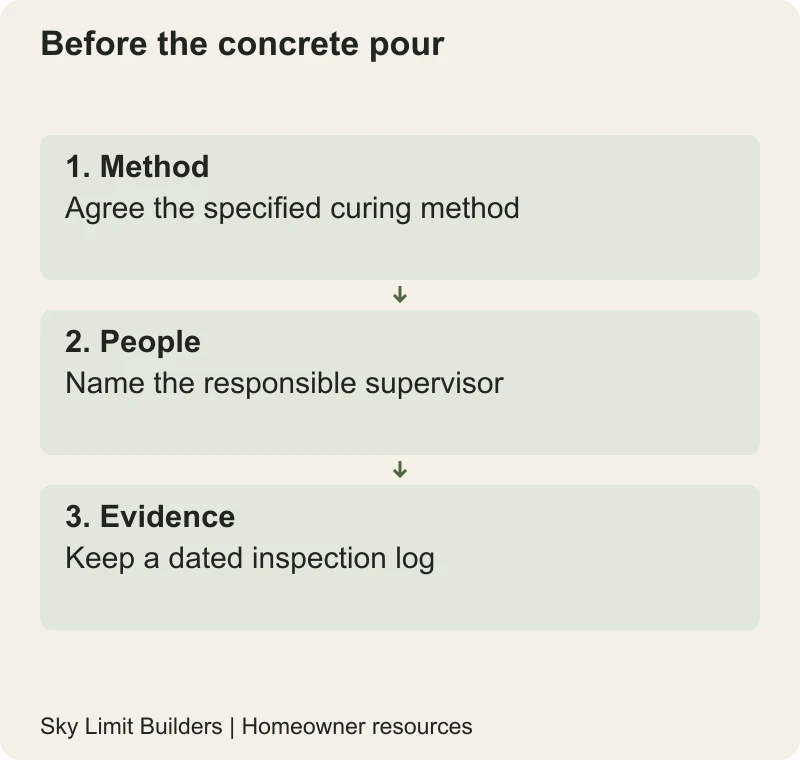
Before a roof slab is poured, decide who will protect and cure the concrete after the placing crew leaves. Buying cement and arranging a pump are only part of the job. A homeowner also needs a written curing method, a responsible person and a way to record interruptions. This guide helps you ask for those arrangements; it does not set a structural design or authorize removal of supports.
What curing does—and what it does not prove
Curing maintains suitable moisture and temperature while cement reacts with water. It is not simply waiting for the surface to look dry. NRMCA’s CIP 11: Curing In-Place Concrete explains why moisture protection must follow placement and finishing, and why alternating wetting and drying is unsuitable. Its guidance is a technical reference, not a substitute for your project specification or Pakistani approval conditions.
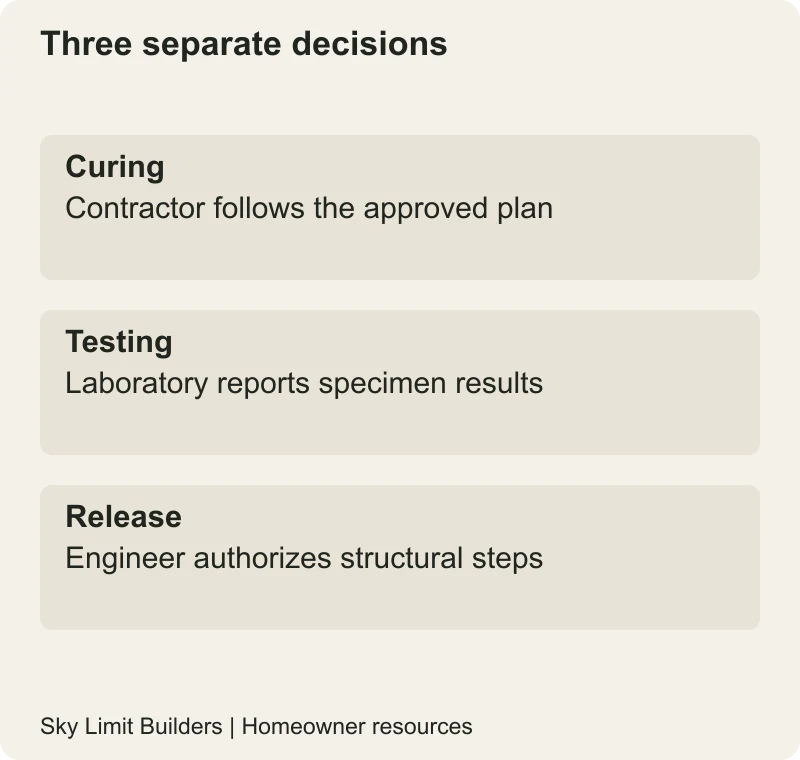
Keep three questions separate when speaking to the contractor: How will the concrete be cured? How will its quality be tested? When may the structure carry construction loads? A satisfactory answer to one does not settle the others. Ask the appointed structural engineer to identify the evidence required for each decision.
Agree on the method before ordering concrete
Ask the contractor to submit a short method statement covering each element: a flat roof, a column and a stair flight do not have identical access or exposed surfaces. The engineer should confirm the method and duration. If the quotation merely says “curing included”, ask what labour, materials and supervision that includes.
Common approaches include maintaining wet coverings, retaining moisture with suitable sheets, and applying a specified curing compound. Water-curing arrangements need a dependable supply; coverings need attention to displacement and exposed edges. A compound also needs compatibility with later bonded finishes. These distinctions are described in CIP 11; obtain the selected product’s current technical sheet rather than treating all products as interchangeable.
- Identify the element and pour reference on the written plan.
- Name the person responsible during the day, overnight and on holidays.
- Record the approved material or product, supplier instructions and available quantity.
- State how workers will safely reach the areas requiring attention.
- Specify who decides whether an interruption needs remedial action.
- Keep the engineer’s release requirements separate from the contractor’s daily checks.
How many days should curing continue?
Do not accept a universal number without checking the specification. The mixture, exposure and project requirements matter. Ask for the required duration or acceptance condition in writing before the pour. A calendar reminder is useful for organising labour, but it is not a structural assessment.
For a Pakistani homeowner managing work remotely, a practical question is: “Who signs the final curing entry, and who separately authorizes the next operation?” Put both responsibilities in your construction contract checklist. If the contractor and engineer give conflicting instructions, pause the disputed next operation and obtain a written resolution.
Plan for site-specific constraints
For a summer pour in Multan, discuss the actual forecast, site exposure and working hours with the supervisor. Do not copy a winter arrangement from another project. Check that the agreed water supply and any necessary power are available before the crew arrives. If there is a supply interruption, the supervisor needs a pre-agreed contact and response, not a last-minute guess from the owner.
Access matters as much as procurement. Ask where hoses and coverings will be stored, who checks them after other trades enter, and how the crew will work near roof edges. Do not climb onto an unfinished roof to collect photographs. A safe viewing position and a supervisor’s recorded inspection are preferable to an owner taking unnecessary risks.
A daily record that is actually useful
The following is an illustrative record, not a mandatory test form. Use it to make missed responsibilities visible. Leave fields blank until observed; do not fill a week of entries in advance.
| Field | What to record |
|---|---|
| Location | Drawing reference, element and pour date |
| Inspection | Date, time and inspector’s name |
| Method | Approved method and condition observed |
| Interruption | Time discovered, affected area and supervisor informed |
| Action | Instruction received, person responsible and follow-up |
| Closure | Reviewer and reference to the project’s release instruction |
A photograph can supplement a log but cannot establish concrete strength. Save photographs under the pour reference so that a later question can be traced to the correct element. Keep delivery records and concrete test records alongside the log, not mixed into an unlabeled messaging thread.
What to do when something looks wrong
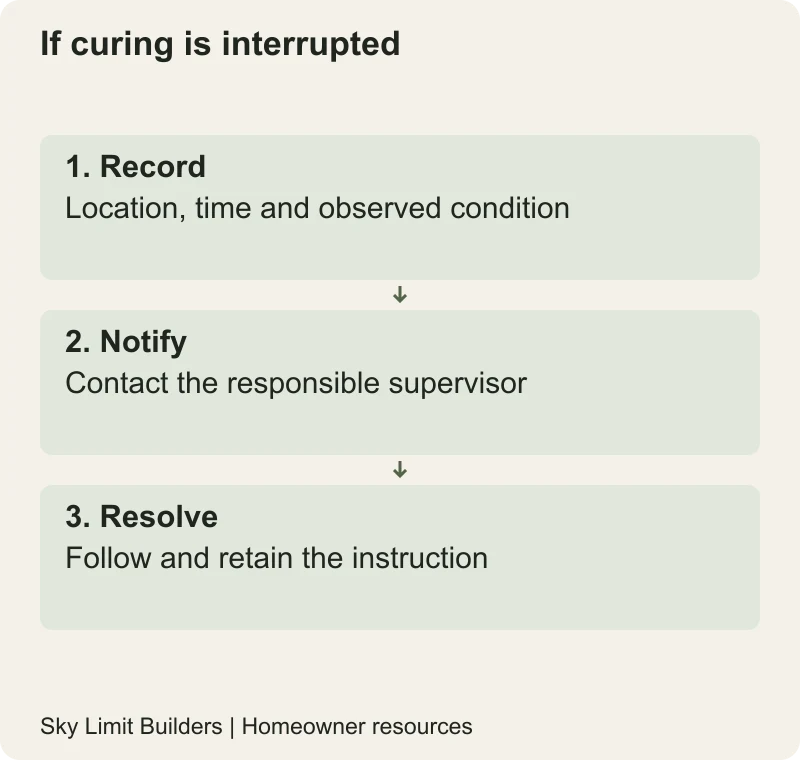
Report uncovered areas, disturbed materials or visible cracking promptly. Record the location and time without declaring the concrete “failed” or “safe” from appearance alone. Ask the engineer what inspection or testing is needed, and retain the response. Do not conceal a concern with a finish before it has been assessed.
End the curing stage with a documented handover: completed records, outstanding concerns and the instruction governing the next activity. Before your next pour, use the checklist above to close gaps in staffing and supplies. For project-specific coordination, contact Sky Limit Builders with the drawings and scope; engineering decisions still require the appointed qualified professional.
Editorial note: AI-assisted, source-checked guide. Project-specific technical decisions require qualified review. Source checked 23 September 2026.