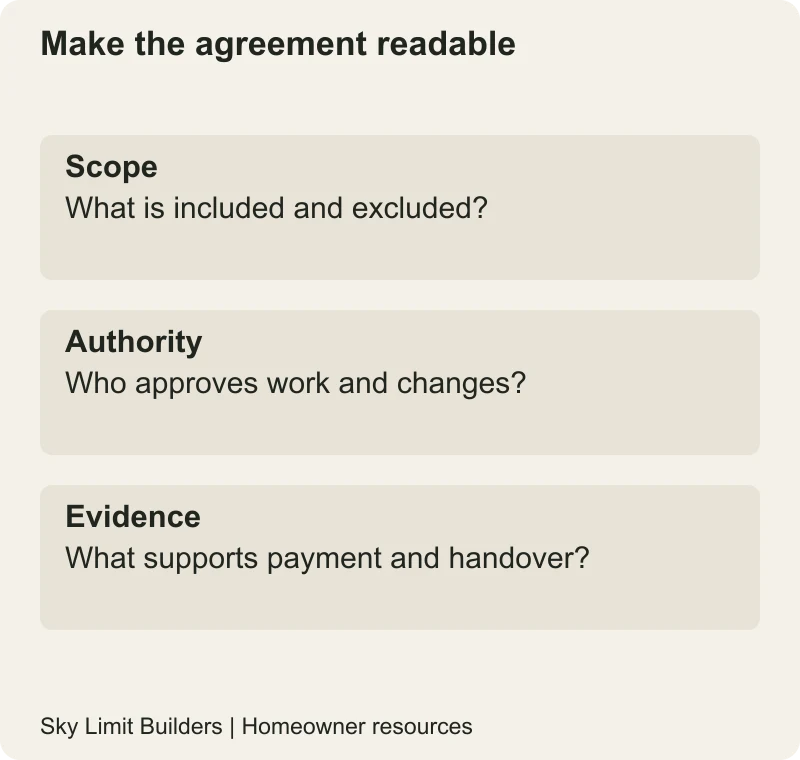
Before signing a house-construction agreement, make sure another person could read it and understand what is included, how payment is earned and who decides changes. A total price with “A-grade quality” written below it does not answer those questions. This checklist helps organize a discussion with the contractor and a qualified contract adviser; it is not a ready-to-sign legal document.
Identify the parties and the document set
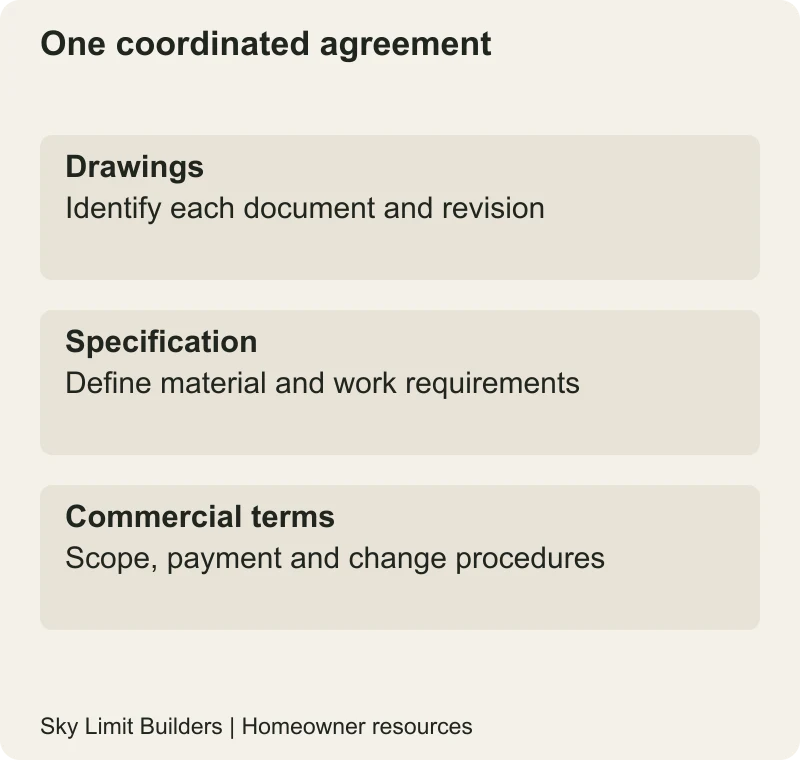
Verify who is contracting, who is authorized to sign and which address or plot the agreement covers. Attach the drawing list with revision dates, specification, scope or bill of quantities, programme and agreed clarifications. Ask the adviser to establish an order of precedence and a process for resolving inconsistent documents.
The Pakistan Engineering Council publishes standard civil-works bidding documents. They are a useful primary reference for understanding structured procurement, but a public-works form should not be copied into a private house contract without checking suitability. Applicable legal and registration requirements need project-specific advice.
Define scope with a responsibility matrix
For each significant package, say who designs it, purchases it, installs it, inspects it and pays relevant charges. Clarify approvals, utility connections, temporary facilities, testing, external works and waste removal. The words grey structure and turnkey are not substitutes for this list.
| Item | Decision to record |
|---|---|
| Material selection | Exact specification or measurable performance and approval process |
| Allowances | What quantity or price basis applies and how differences are treated |
| Measurement | How quantities and covered area are established |
| Owner-supplied items | Delivery date, storage, installation and responsibility for delay or damage |
| Specialists | Named appointment or clear responsibility to arrange qualified input |
If a proposed material is unavailable regionally, agree the substitution procedure before that situation occurs. Require a written comparison of the specification and cost/time effects instead of allowing any item described as “equivalent”.
Make payments and changes traceable
Ask what evidence supports each payment application and who verifies it. Distinguish advance payments, measured progress, stored materials and final settlement. Do not assume a standard retention percentage or that payment automatically means technical acceptance; have the terms drafted for your agreement.
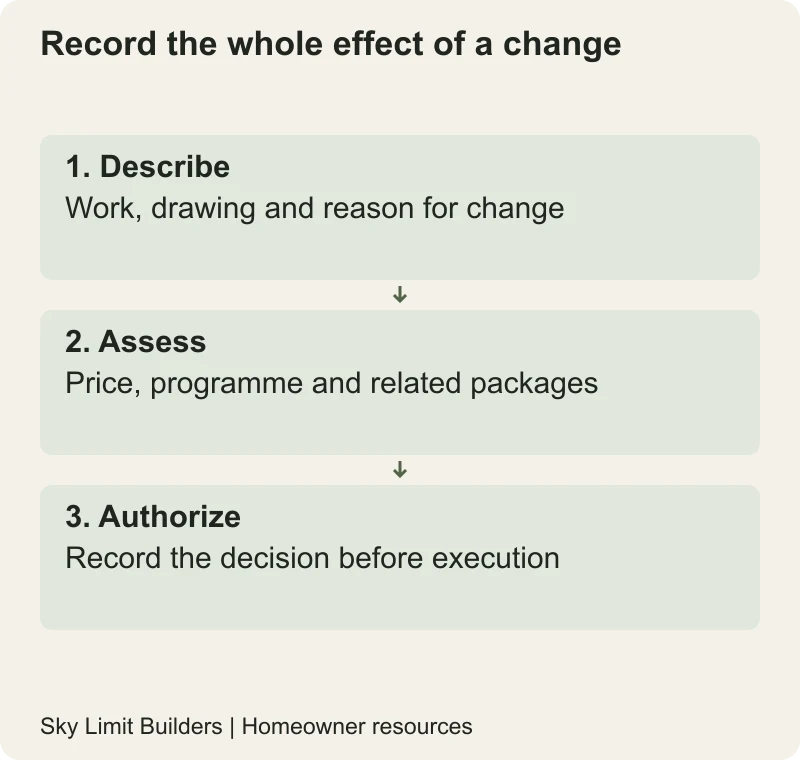
For a change, record the requested work, revised drawing or instruction, price effect, time effect and authorization. As an illustrative example, moving a bathroom may affect plumbing, waterproofing and finishes—not only the new fixture position. Obtain the combined effect before agreeing the change, subject to any urgent-safety provisions in the contract.
Agree a programme and a decision process
Identify the start conditions, key milestones, intended completion and information the owner must provide. Ask how delays are notified and assessed and how the programme is updated. Keep dated records of decisions and instructions. Avoid promising a completion date based only on the plot size when design, approvals or material selections remain unresolved.
Set out who may instruct site changes. A family member commenting during a visit should not inadvertently create a disputed instruction. For an overseas owner, define the representative’s authority and how approvals will be recorded.
Quality, safety and handover belong in the agreement
Include inspection hold points and test records, not only a broad promise of good workmanship. The quality checklist can help identify work that should be reviewed before concealment. Ask the adviser to address site control, neighbours, insurance, taxes, termination and dispute procedures without assuming these are covered by a short quotation.
Define what documents and demonstrations are required at handover and how defects are reported and closed. Read the handover guide before agreeing final-payment conditions.
Before you sign
Gather every referenced attachment and check that both sides hold the same version. Resolve blank allowances and contradictory exclusions. Have a qualified adviser review the legal terms, and retain a signed complete copy. When requesting a construction proposal, provide the same coordinated document pack to each bidder so the prices can be compared fairly.
Legal note: these are preparation questions, not legal advice or an approved contract form. No universal payment, retention, tax or defects-period rule is asserted.