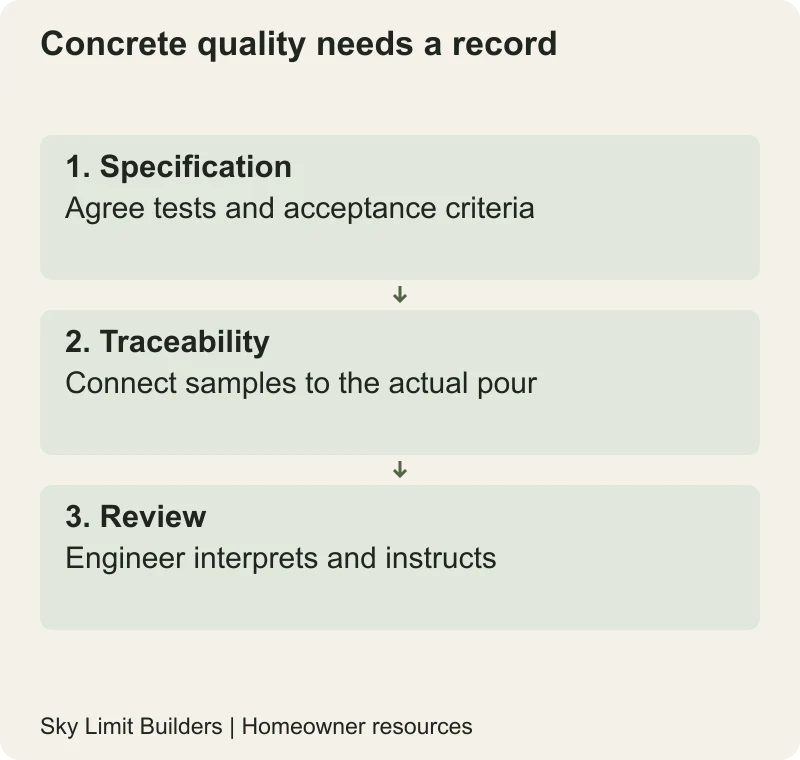
A concrete result is useful only when it can be traced to the right pour and interpreted against the project specification. Before a slab or foundation is placed, agree who will sample, test, label and report the concrete—and who has authority to act on an unexpected result. Do not leave those responsibilities until the truck is waiting at the gate.
Separate fresh-concrete checks from strength testing
NRMCA’s CIP 41: Acceptance Testing of Concrete distinguishes tests on representative fresh samples from tests on hardened concrete. Slump is a fresh-concrete consistency check; it is not a direct measurement of compressive strength. Ask the engineer which tests and acceptance criteria apply to the approved mix and placing method.
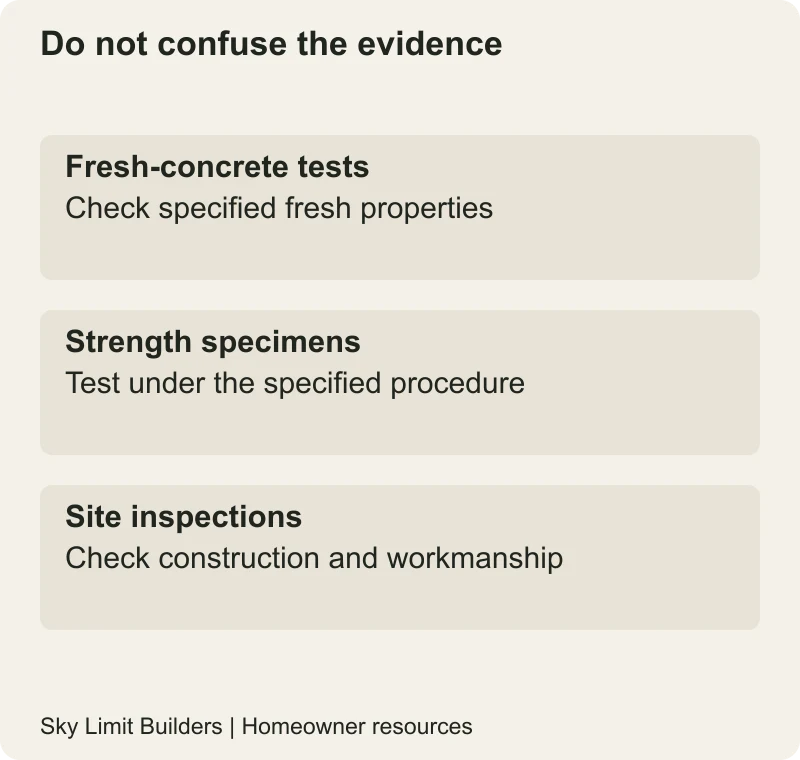
Do not accept “the slump looked fine” as a complete quality record. Equally, a strength report does not demonstrate that reinforcement, cover or placement were correct. Those need their own inspections. Use the stage inspection guide to keep the responsibilities separate.
Agree a sampling and reporting plan
Before the pour, ask the designer and testing provider to identify the specified method, sampling frequency, specimen type, test ages and reporting route. Cubes and cylinders should not be mixed up in the paperwork. Do not apply a casual conversion factor to compare results obtained using different methods.
NRMCA’s CIP 35: Testing Compressive Strength of Concrete explains the distinction between standard-cured specimens used for acceptance and field-cured specimens used to help assess in-place conditions. It also warns that specimen preparation, handling and testing can affect results. These are technical references; the engineer must establish the project’s governing standards rather than importing an American acceptance rule without review.
Create a traceable pour record
| Record | Purpose |
|---|---|
| Drawing and element reference | Identify where the concrete was placed |
| Mix and batch or delivery reference | Connect the material to the approved order |
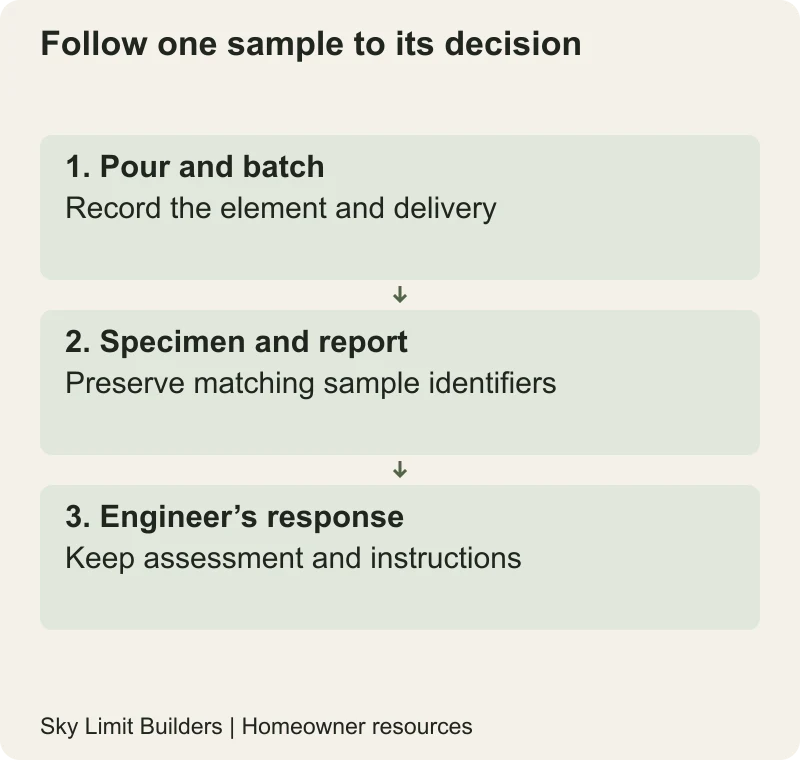
| Sample and specimen identifiers | Connect each report to its source sample |
| Sampling and test dates | Establish timing and the reported test age |
| Observations and changes | Preserve relevant delays, adjustments and instructions |
| Reviewer and response | Record who assessed the result and any follow-up |
The exact form should be agreed with the testing provider. Use durable identifiers and reconcile the sample list with the laboratory’s receipt. A handwritten “roof concrete” label is ambiguous if the project has several roof pours. Keep original reports rather than a cropped photograph showing only one number.
Know who can change or reject a delivery
The pre-pour meeting should resolve the decision chain for a delayed load, a result outside the specified range or a proposed adjustment. Ask who must be contacted and where an instruction is recorded. The homeowner should not direct a worker to add water because the concrete appears difficult to place.
Check that the placing team, supplier and testing personnel have the same mix identification and current instructions. If site-mixed concrete is specified, the engineer still needs to define its production controls and evidence; the absence of delivery tickets is not a reason to abandon traceability.
Respond to an unexpected strength result carefully
Send the complete report to the engineer and preserve the related site records. Ask whether the result corresponds to the specified age and method, whether sampling or curing issues were recorded, and what actions are required. Do not declare the structure safe or unsafe from one number alone.
CIP 35 notes that an early-age result is not itself a rejection basis when the specified strength requirement is at a later age. That does not mean an early warning should be ignored: it should be assessed promptly by the responsible engineer. Any additional investigation, restrictions or remedial work must be project-specific.
Keep curing and testing connected—but distinct
Arrange protection and curing of the actual structure as well as appropriate specimen handling. A laboratory report does not replace a site curing plan or authorize removal of supports. Ask the engineer what separate evidence is required for loading and the next structural operation.
Before your next pour, prepare a one-page contact and responsibility sheet, confirm the laboratory booking and check that records will reach the reviewer. For a construction coordination discussion, bring the structural specification and existing test reports. This makes the conversation about evidence rather than guesswork.
Engineering note: this is a homeowner’s record-and-responsibility guide, not a testing procedure or structural acceptance decision. Original illustrations are conceptual; qualified personnel must perform tests to the specified standards.