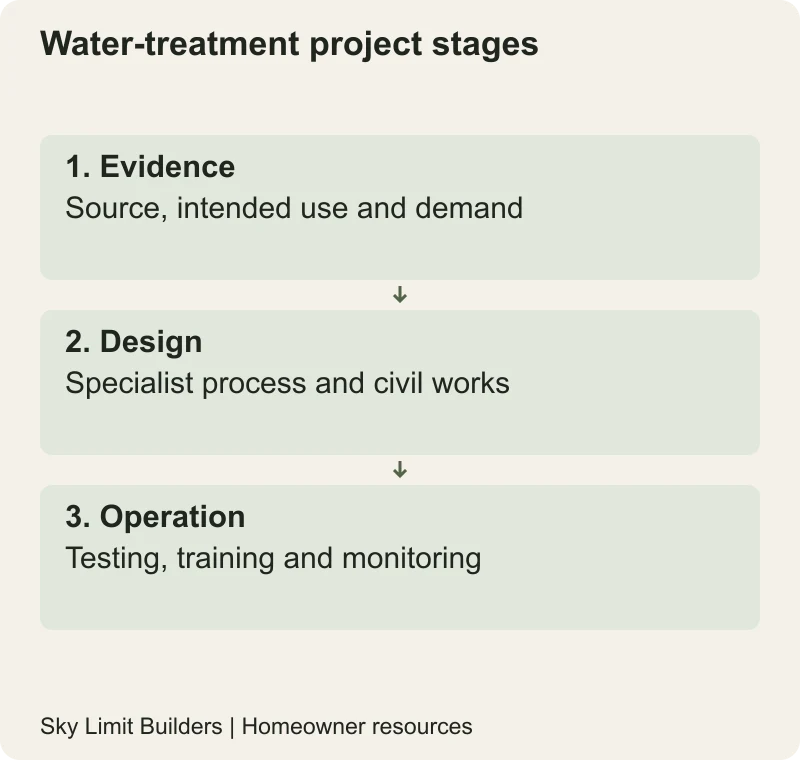
A water-treatment project needs a defined source-water problem, a designed treatment process and an operating plan—not just a tank and a filter on a drawing. For a housing development or building owner, the first useful task is to establish what water is available, what it will be used for and who will remain responsible after commissioning.
Separate the water uses
Drinking-water supply, construction-process water and non-potable landscape water have different acceptance questions. Do not assume water suitable for one use is suitable for all others. Ask the relevant designer to specify testing, intended use and any separation of systems. This guide concerns the project brief and civil-work interfaces; it does not give a treatment recipe or certify a source as safe.
The WHO Water Safety Plan Manual, second edition (2023) provides risk-management guidance for drinking-water suppliers, including operational and compliance monitoring resources. Its value to an owner is the reminder that safe supply depends on the whole system and continuing operation, not simply a one-time equipment purchase.
Prepare evidence for the treatment designer
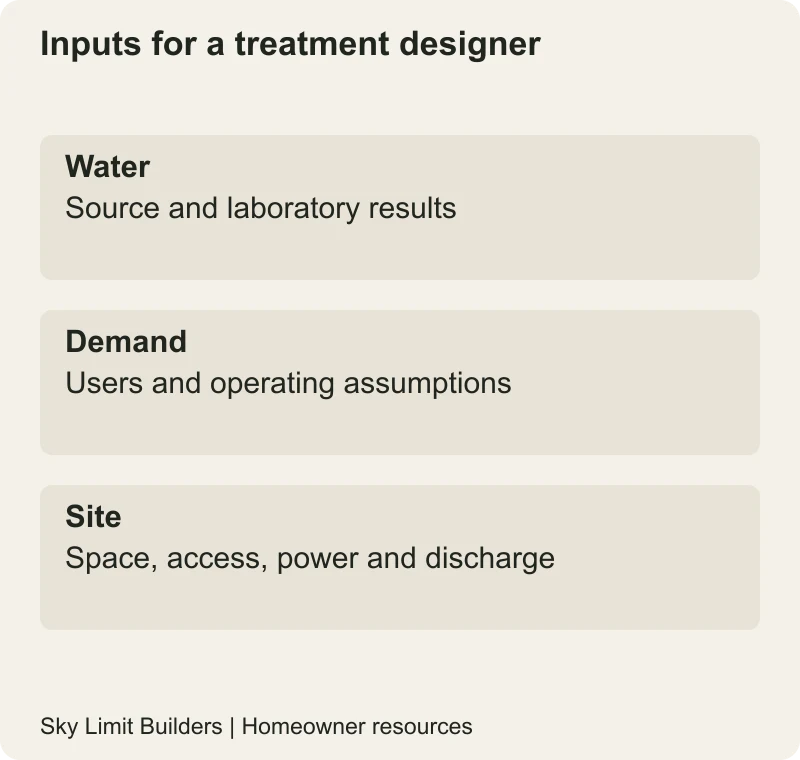
- Identify the proposed source and any permissions or supply agreement needed.
- Provide sampling results from an appropriate laboratory, including dates and sampling locations.
- Describe the intended users, demand assumptions and expected changes in demand.
- Record available space, access, electricity arrangements and maintenance constraints.
- Identify where residuals, wash water or other process discharges could lawfully go.
Ask the specialist whether sampling represents relevant seasonal conditions. A single clear-looking sample is not a design basis. In Pakistan, permissions and utility responsibilities depend on location and the type of supply; obtain written requirements from the responsible regional authority or utility rather than assuming one national approval checklist applies everywhere.
Coordinate the civil works with the equipment
Before constructing equipment bases or rooms, obtain approved loads, anchor requirements, maintenance clearances and connection drawings from the responsible specialists. Resolve how equipment will be removed for repair, not just how it will fit on installation day. Agree drainage, floor levels, safe access, electrical interfaces and identification of potable and non-potable routes.
A practical review question is: can a technician isolate and replace a component without contaminating the supply or dismantling unrelated building work? Put the answer into the design and operating procedure. Do not use this question as permission for untrained staff to work on a live system.
Define commissioning before awarding the work
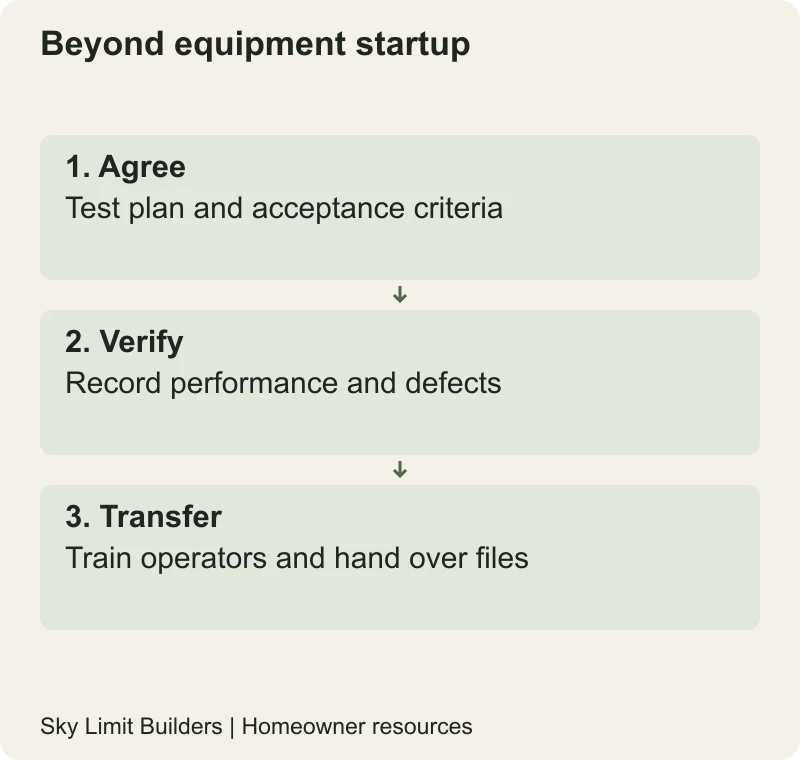
Commissioning is the documented process of checking that the completed installation performs as specified and can be operated as intended. Ask for an agreed test plan, sampling responsibilities, acceptance criteria, defects process and operator training. Distinguish the equipment supplier’s startup demonstration from independent verification required by the project or authority.
The handover file should identify operating instructions, maintenance schedules, consumables, spare parts, contacts, test results and as-built drawings. Record who reviews monitoring results and what happens when a result is outside the specified limits. Buying equipment without assigning these responsibilities leaves an operational gap even when civil construction appears complete.
Next step for an owner
Commission a source-and-demand assessment before seeking a fixed treatment package. Bring the resulting brief to the civil, mechanical, electrical and water specialists together. For related building interfaces, read our residential plumbing guide and utility coordination guide. Contact Sky Limit Builders to discuss the construction scope without assuming that this article documents a completed company treatment project.
Public-health and engineering note: water treatment requires qualified design, appropriate testing and applicable approvals. No treatment dosage, drinking-water safety claim or company project history is asserted here.