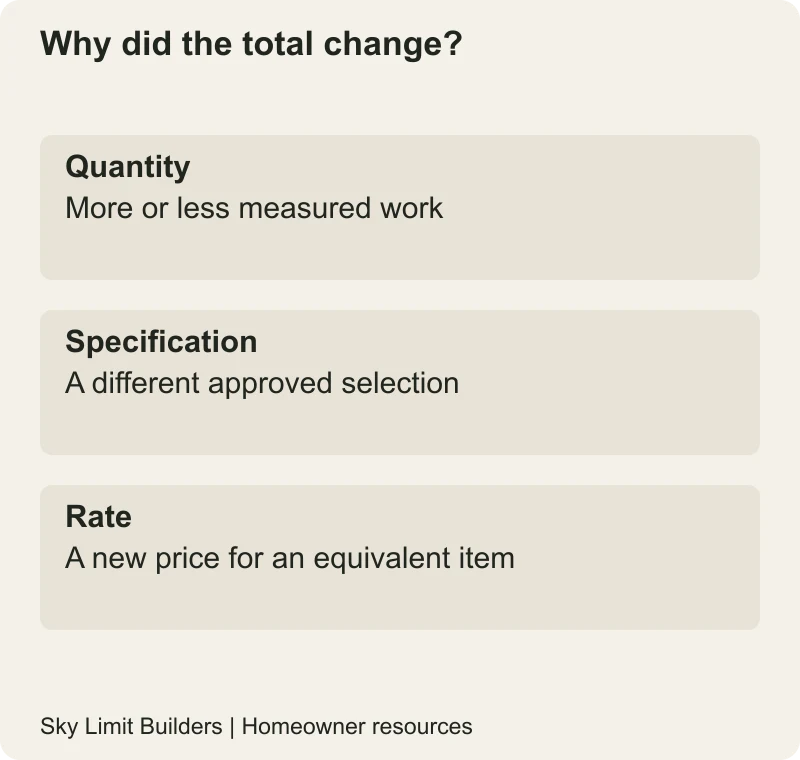
When a construction quotation rises, first identify whether the change comes from a new quantity, a changed specification or a higher unit price. These are different issues and require different responses. This guide shows how a Pakistani homeowner can track price exposure without relying on unsupported predictions about the market.
Separate three causes of a higher total
| Change | Example | Check |
|---|---|---|
| Quantity | The revised drawings add more work | Measure the difference against the drawing revision |
| Specification | A selected product replaces a provisional allowance | Compare approved products and the allowance rules |
| Rate | The same item has a different delivered unit price | Compare dated quotations with equivalent terms |
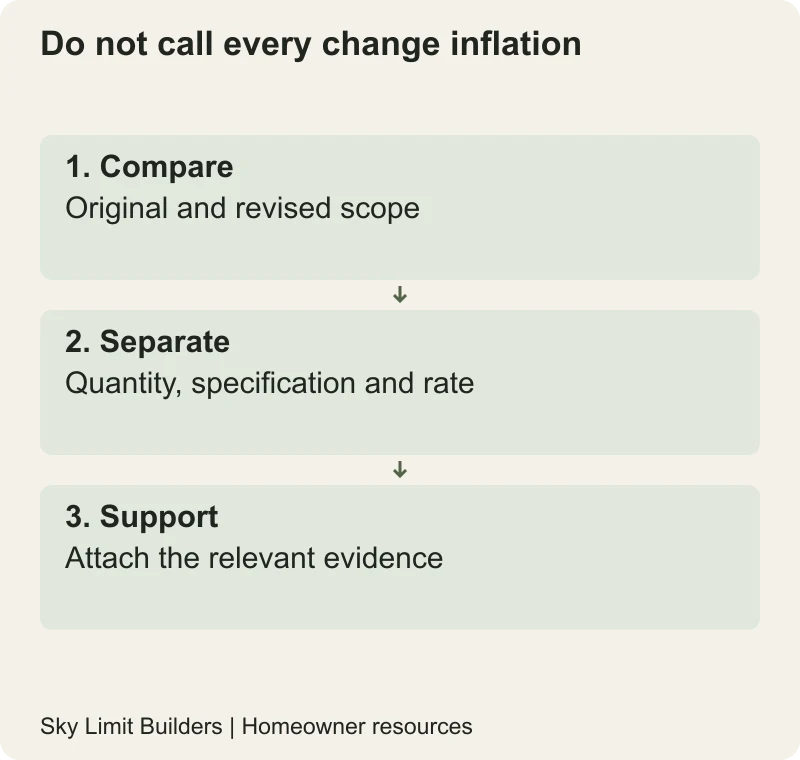
Do not call all three “inflation.” A written comparison helps identify what the owner changed, what the contractor assumed and what market evidence supports. The budget guide explains how to keep the original scope visible.
Use dated evidence with the right units
The Pakistan Bureau of Statistics’ December 2025 release includes links to construction-item price tables. They are historical observations, not today’s offer from a Multan supplier. Check period, location, item description and unit before using any statistic for context.
For purchasing decisions, ask suppliers to show the exact product, quantity, delivery location, taxes, unloading, payment conditions and validity date. A factory-gate price cannot be compared directly with a delivered-to-plot price. A changed pack size or product grade can also make a headline price misleading.
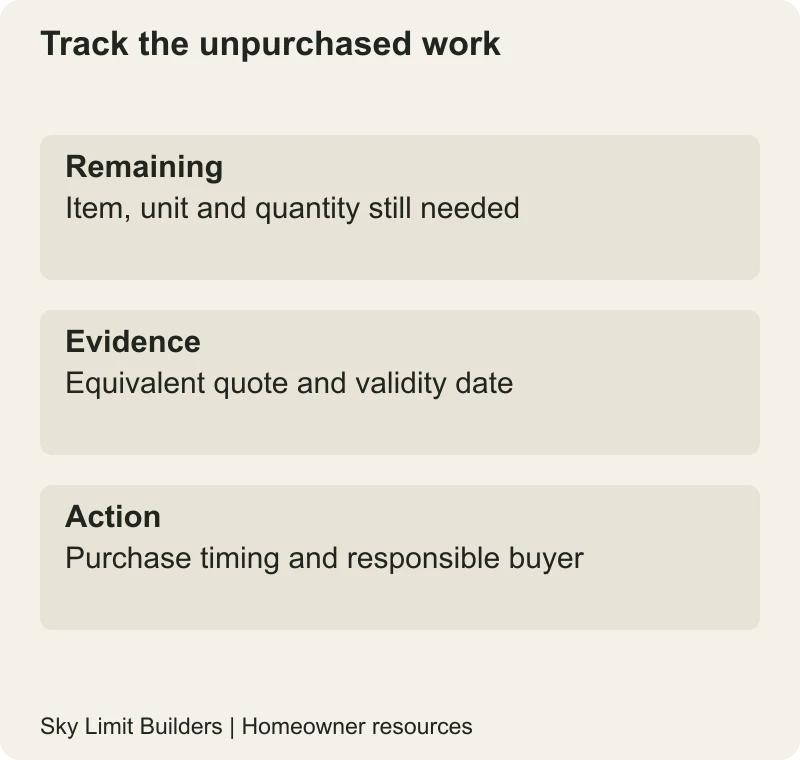
Keep a simple exposure register
List major unpurchased items, the quantity still required, the latest comparable quote, the planned purchase date and the responsible buyer. Add any contractual limit or adjustment mechanism. This is more useful than collecting screenshots of national price headlines with no connection to the remaining work.
Illustrative arithmetic only: if 100 units remain to be bought and an equivalent quote increases by 20 rupees per unit, the direct purchase difference is 2,000 rupees before any other contractual effects. Those figures are invented solely to explain the calculation; they are not a material price, market forecast or actual company transaction.
Discuss procurement timing without gambling on prices
Buying earlier may reduce one exposure while creating others: storage, damage, financing, theft, unsuitable substitutions or a design that later changes. Ask whether drawings and quantities are stable and whether the contractor can safely store and identify the material. Do not stockpile safety-critical products simply because someone predicts a price jump.
For a long-lead item, obtain the supplier’s actual programme and clarify what a deposit secures. Record cancellation and delivery terms. If a cheaper substitute is proposed, obtain the designer’s assessment before treating it as a saving.
Follow the contract when a claim arrives
Ask for the relevant clause, affected item, original basis, new evidence and calculation. Keep disputed amounts separate from agreed progress records and obtain appropriate professional advice. Neither a news report nor a supplier message automatically creates a contractual entitlement. See the contract checklist for the questions to settle before work begins.
At the next budget review, update committed costs and the forecast to finish, not just money already paid. This gives you time to adjust nonessential scope with the design team before funds are exhausted. No investment or commodity-price prediction is made here.
Editorial correction: the previous article’s unverifiable bibliography, purported interviews and unsupported forecasts have been removed. The linked PBS release is explicitly dated and is not represented as a current quotation.