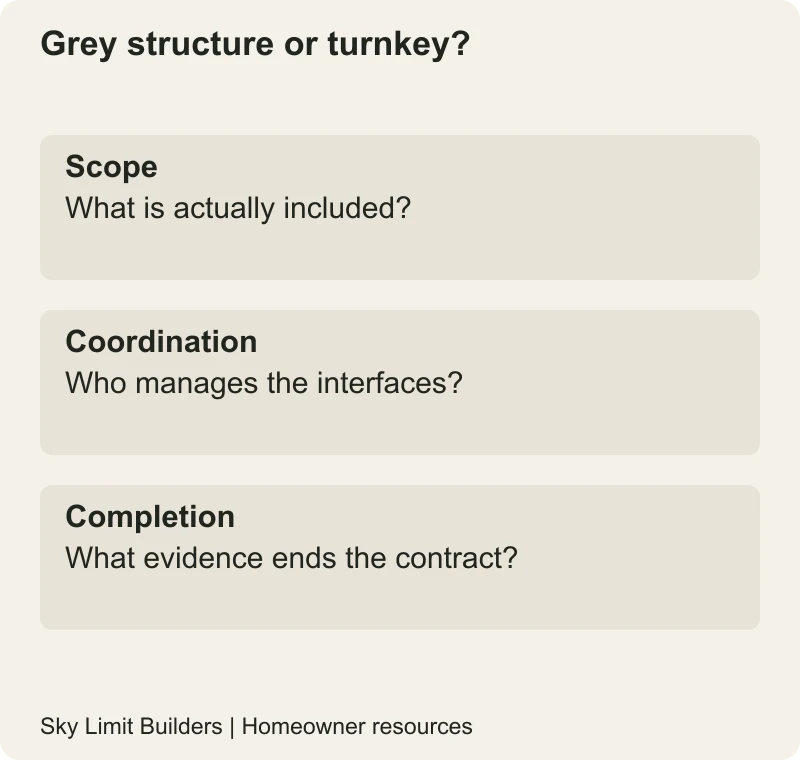
Grey structure and turnkey are descriptions of contract scope, not different structural engineering systems. A grey-structure contract stops before some or all finishing work; a turnkey proposal aims to deliver a more complete result. Neither label guarantees what is included, how much owner involvement is needed or whether the house is legally ready for occupation.
Compare responsibilities, not slogans
| Decision | Grey-structure route | Turnkey route |
|---|---|---|
| Finishing coordination | Usually needs a separate owner-appointed arrangement | May sit with the main contractor if expressly included |
| Selections | Later choices still need early service coordination | Allowances and approval dates should be set before work |
| Interfaces | Handoff between teams requires clear records | Internal subcontract interfaces still require supervision |
| Budget comparison | Compare the full cost to finish, not only the first contract | Check exclusions, provisional sums and owner purchases |
The grey-structure scope checklist helps establish the first package. Turnkey quotations should be equally explicit about design, permissions, utility connections, testing, fixtures, appliances and external work.
When separate packages can make sense
An owner may want to appoint specialist finishers, stage expenditure or make selected purchases directly. That can be workable when there is a realistic complete budget and someone competent to coordinate the interfaces. It is not automatically cheaper: repeated mobilisation, protection, unresolved details and duplicated work can affect the final account.
If work pauses between stages, ask how the incomplete building will be protected, who checks its condition before restart and whether approvals or contracts impose relevant deadlines. Do not assume a bare structure can be left without a maintenance plan.
When a more integrated contract can help
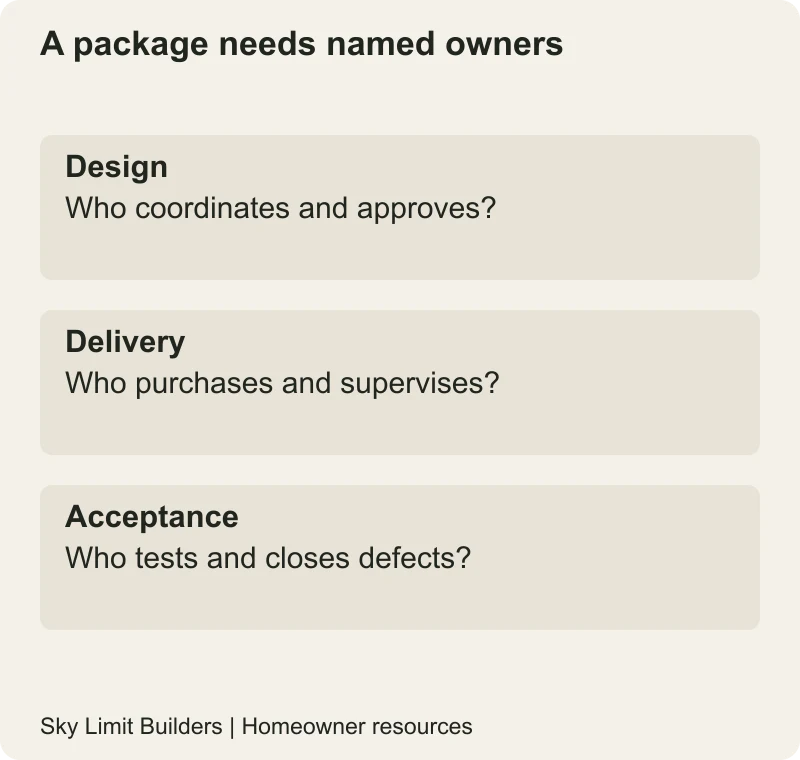
A single contracting point can simplify communication, particularly for an owner who cannot attend frequently. It does not remove the need to review selections, verify progress and obtain independent advice where appropriate. Ask whether the quoted team actually controls design and subcontractors or merely passes their invoices through.
A turnkey promise is weak if the finish specification says only “premium.” Agree exact selections or clearly defined allowances, substitution procedures and sample approval. Explain how an allowance is reconciled when the chosen item costs more or less than the budgeted amount.
Use one interface example to test the proposal
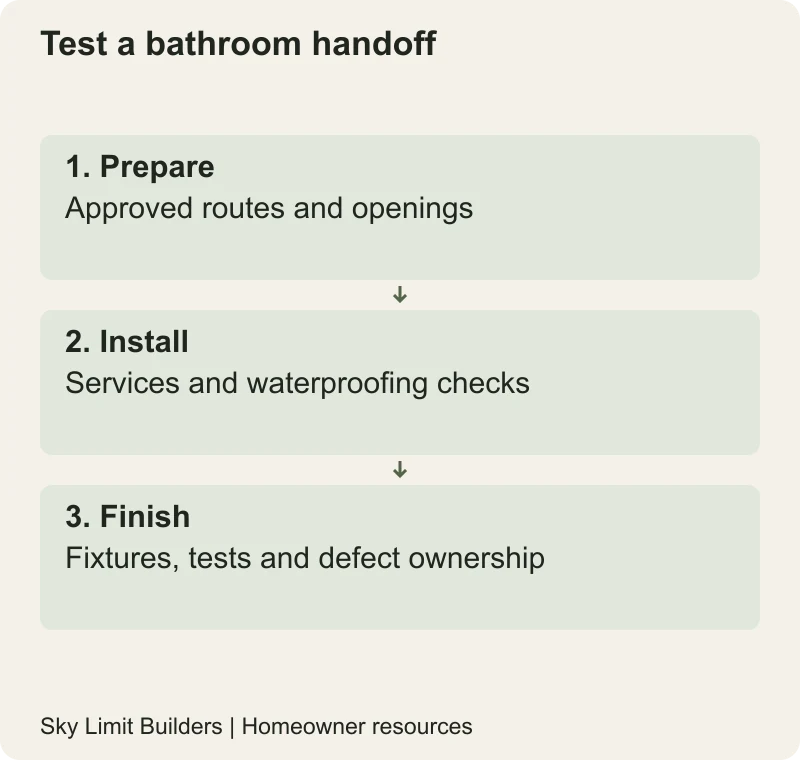
Take a bathroom from design to handover. Who locates the drain, forms the opening, installs and tests the pipes, applies waterproofing, lays tiles, installs fixtures and verifies the completed result? Who repairs damage if one trade affects another’s work? Ask both bidders to answer the same questions.
This example reveals responsibility more clearly than a broad claim that “everything is included.” Use the plumbing guide to identify records and access requirements.
Put commercial safeguards in the agreement
Record scope, payment evidence, change approval, delay treatment, defects and completion obligations. The PEC standard civil-works bidding document is an official example of structured procurement documentation, not a ready-made private-house agreement. Have a suitable adviser adapt contractual terms to your project instead of copying clauses without understanding them.
Choose the route that matches your coordination capacity and risk tolerance after comparing the complete scope. Read the contract checklist, then obtain clarified proposals. Do not choose on a headline claim of guaranteed savings or a “hassle-free” label.