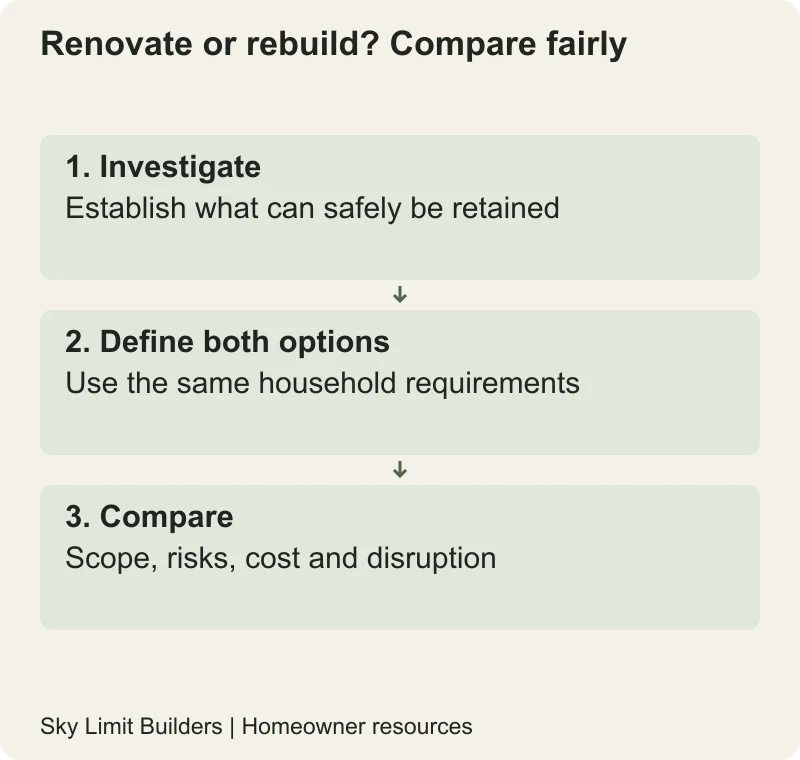
Compare renovation and rebuilding only after establishing what the existing house can safely retain. Fresh paint, an attractive facade or a contractor’s per-square-foot rate cannot answer that question. Start with a condition assessment, then price two clearly defined options against the same household requirements.
Separate known defects from unanswered questions
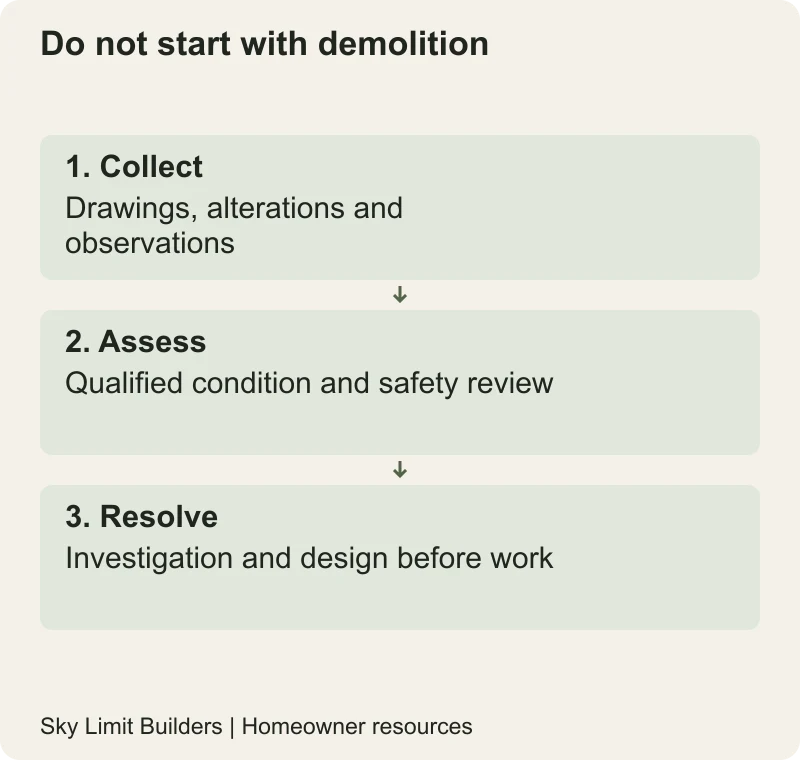
Collect available drawings, records of alterations and a list of observed problems. Note where cracking, damp or service failures occur without diagnosing them yourself. Have appropriately qualified professionals assess the structure and services and recommend any further investigation needed.
The UK Health and Safety Executive’s structural-stability guidance for alteration and demolition emphasizes competent planning to avoid unintended collapse. It is cited for safety principles, not as Pakistani law. Removing a wall, cutting a slab or dismantling part of a building is not an exploratory homeowner exercise.
Define what you want to change
Write the same brief for both options: required rooms, accessibility, parking, daylight, services, comfort and intended occupancy. Identify which existing features genuinely matter to the household. Do not describe one option as a full new house and the other as only repainting if the actual need is a substantially different layout.
Ask the architect to distinguish retained work, removed work and new work on the renovation proposal. If many assumptions are marked “confirm on site”, identify their cost and programme consequences before calling the quotation fixed.
Compare whole-project costs
| Cost area | Questions to investigate |
|---|---|
| Design and approvals | What professional input and authority process does each option require? |
| Site work | What is removed, protected, strengthened or newly built? |
| Services and finishes | Which items are retained, replaced or excluded? |
| Living arrangements | Can the house remain occupied safely, or is temporary accommodation needed? |
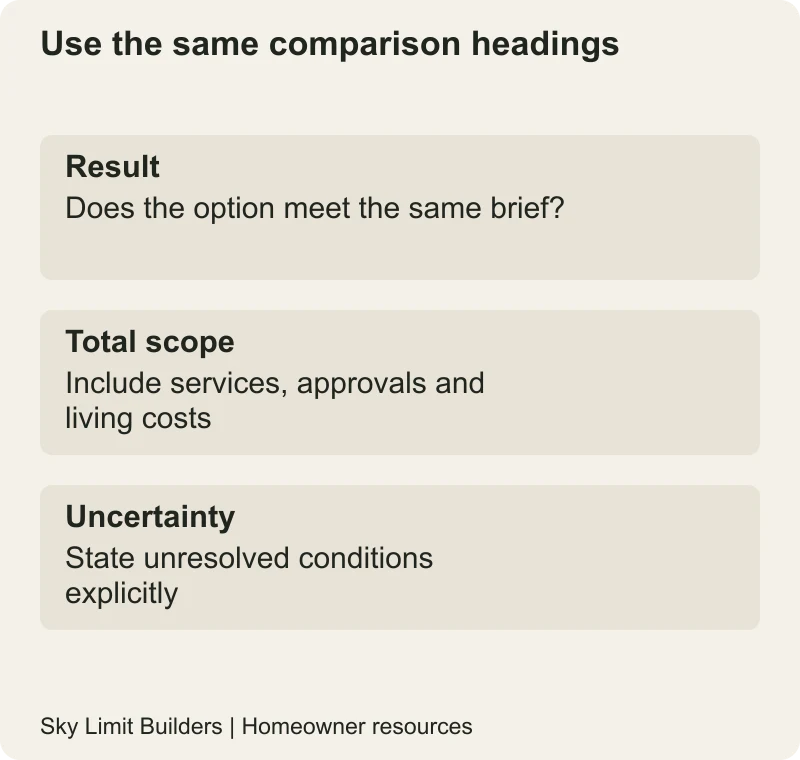
| Uncertainty | Which provisional items need investigation before a dependable price? |
Ask for dated regional quotations with quantities and exclusions. There is no universal percentage at which rebuilding automatically becomes better value. The decision also depends on how long you intend to use the property, what can be retained and whether the desired result is feasible.
Check approvals before choosing the label
Describe the actual work to the relevant development authority, cantonment or society and obtain current requirements. Calling a project “renovation” does not establish that structural changes, additional floors or altered use can proceed without approval. Have the project adviser determine what applies to your address.
If the existing building differs from available approved drawings, resolve that uncertainty before designing around it. For a prospective purchase, connect this review with the property due-diligence checklist and independent legal advice.
Plan the transition, not just the finished rooms
Ask the contractor how occupants, neighbours, utilities and retained parts of the building will be protected. Agree access, isolation, waste handling and the sequence of work with competent professionals. If people are expected to remain in the house, have that arrangement explicitly assessed; do not assume that closing an internal door makes a work zone safe.
For a kitchen or bathroom renovation, coordinate the service routes and tests before approving finishes. Unknown existing wiring, pipes or waterproofing should be investigated rather than hidden behind new surfaces.
Use a decision record
Record the preferred option, the evidence supporting it and the conditions that could change it. An illustrative conclusion might be “retain the assessed structure, subject to the engineer’s strengthening design and a revised services quotation”. That is more useful than “renovation is cheaper”, because it identifies what still has to happen.
Before appointing a contractor, compare both options at a similar level of detail and put unresolved items into the contract clarification list. For a project discussion, bring the condition information and your household brief rather than requesting a rate without a scope.
Safety and financial note: this is a comparison framework, not a structural diagnosis, demolition method or valuation. Obtain qualified engineering, approval and contractual advice before committing to work.