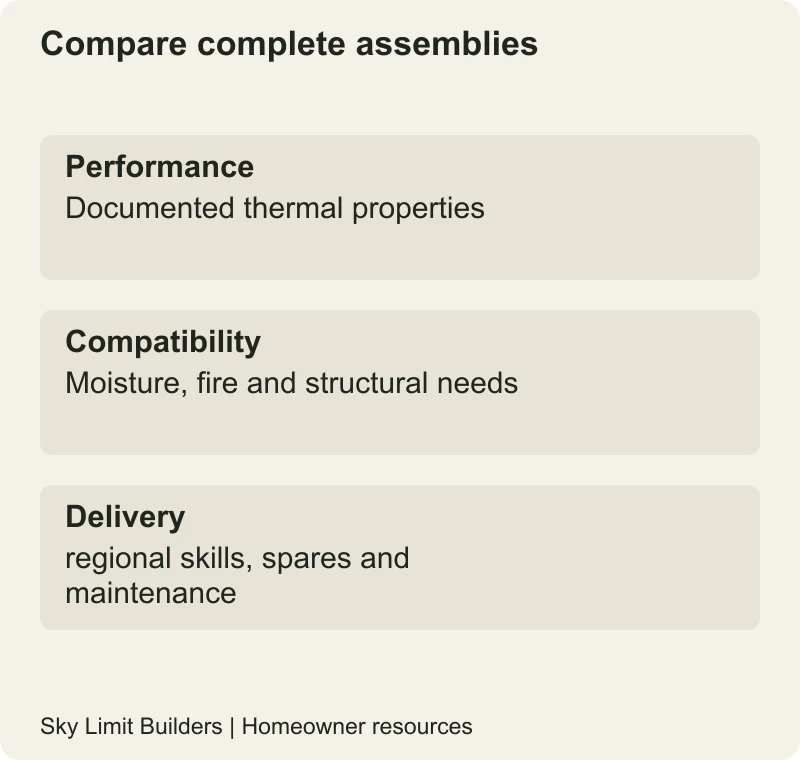
Compare hot-climate materials as parts of a complete roof, wall or window assembly. A product’s label alone cannot predict a room temperature or electricity bill. For a Pakistani house, the useful comparison combines documented performance, moisture and fire requirements, installation quality, regional availability and maintenance.
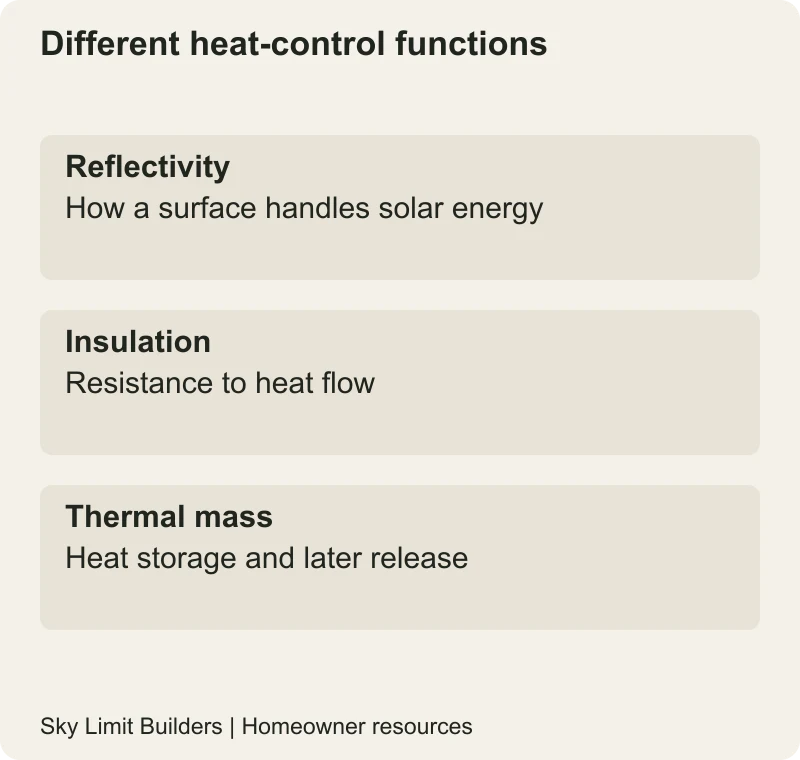
Keep three different heat-control ideas separate
| Idea | What to ask about |
|---|---|
| Reflective surface | Documented solar performance, ageing, cleaning and compatibility |
| Insulation | Declared thermal resistance, continuity, protection and installation |
| Thermal mass | How stored heat interacts with the climate and daily operation |
These functions are not interchangeable. A thin reflective coating is not the same as an insulation layer, and a heavy wall is not automatically a highly insulating wall. Ask the designer to explain which problem each proposed component addresses.
Roof products: compare the full build-up
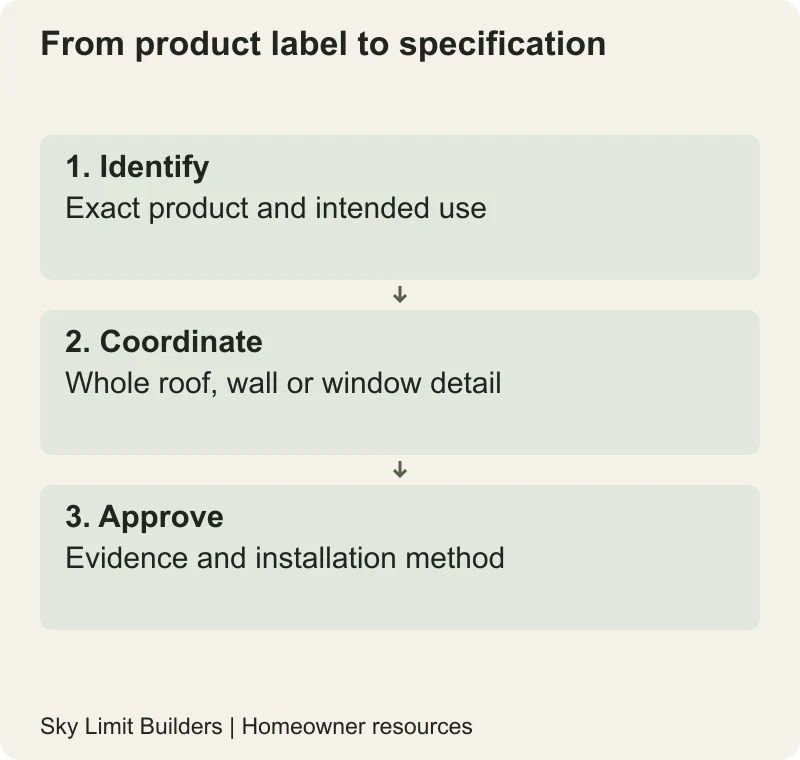
The US Department of Energy cool-roof guide explains reflective roofing and why suitability depends on the building and climate. It does not promise a fixed indoor-temperature change. Obtain product-specific information and coordinate the finish with waterproofing, drainage, access and any insulation beneath or above it.
Ask who is responsible if a proposed coating is incompatible with the existing roof. For a retrofit, inspect the underlying roof condition before comparing prices. Adding layers without checking loads, levels and outlets can introduce problems unrelated to thermal performance. The roof improvement guide provides a decision sequence.
Walls: request assembly evidence
When comparing fired brick, concrete masonry or AAC, request the exact unit properties and proposed wall detail. Include thickness, finishes, insulation if any, joints and fixings. Ask about regional installer experience and how services, heavy fixtures and moisture interfaces will be handled.
Do not claim that a wall product makes a building earthquake-safe or guarantees a particular temperature reduction. Structural suitability and thermal performance are separate assessments. Use the masonry selection guide for material identity and acceptance questions.
Windows: include the frame and installation
Compare the whole window, not only the number of panes. Ask for documented thermal and solar performance, air-leakage information where available, opening operation, seals, drainage and maintenance. The Department of Energy window guide explains performance ratings and component effects. Use those concepts to question suppliers rather than treating a frame material as a universal winner.
Ask the designer how orientation and shading affect the selection. A more expensive window does not resolve an inappropriate opening position or an installation gap. Request a sample and approved installation details before ordering the entire house.
Make regional supply part of the comparison
For a Multan delivery, establish the exact product source, lead time, replacement availability and installer support. Ask whether quoted alternatives are technically equivalent and obtain designer approval before substitution. Keep current datasheets, invoices and installation records with the house file.
Compare options by installed cost and documented suitability, not by an unsupported “pays for itself” claim. If savings are part of the decision, request a transparent calculation with operating assumptions. The next step is a coordinated specification for the actual house, supported by the Multan design checklist.
This guide does not specify structural, fire or moisture-safety details. Have the responsible professionals approve the complete assemblies.